
New Build or Existing Stock? Why Existing German Property Still Beats New Build in 2026

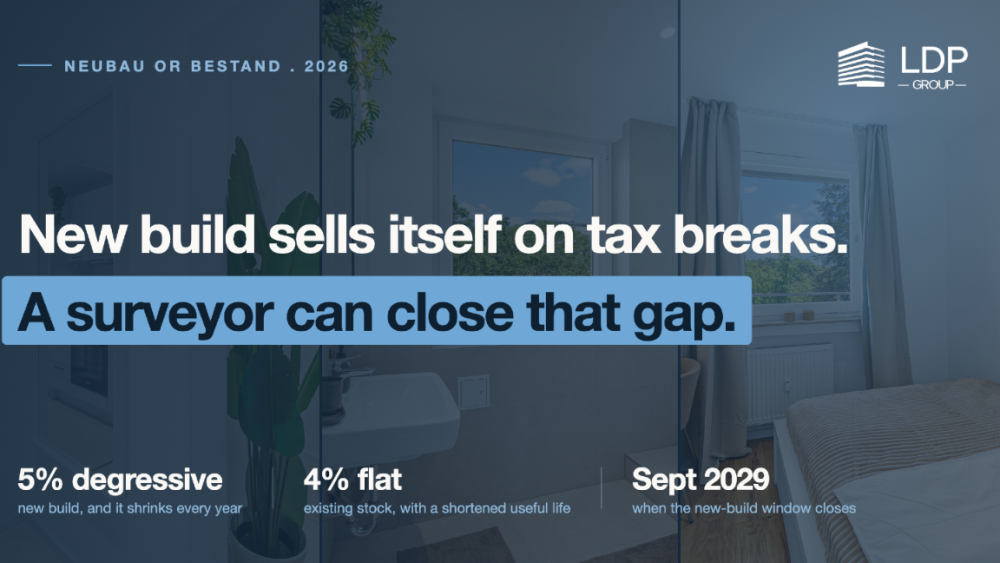
New Build or Existing Stock? Why Existing German Property Still Beats New Build in 2026
Ask a German developer's sales agent, and the answer is obvious. New build: no maintenance, better energy rating, 5% degressive depreciation, tenants who pay a premium.
But what is the better investment?
Yield is a fraction, and the denominator is the purchase price
Rental yield is annual rent divided by what you paid. New-build pricing per square metre in most German cities runs far above comparable existing stock in the same district, but achievable rent does not scale in the same proportion.
Rents in Germany are constrained. Mietspiegel, Mietpreisbremse, Kappungsgrenzen and simple tenant affordability all cap what a new-build apartment can charge relative to a well-maintained older one two streets away. You might achieve a premium of 15 or 20%. You paid a premium of 60 or 80%.
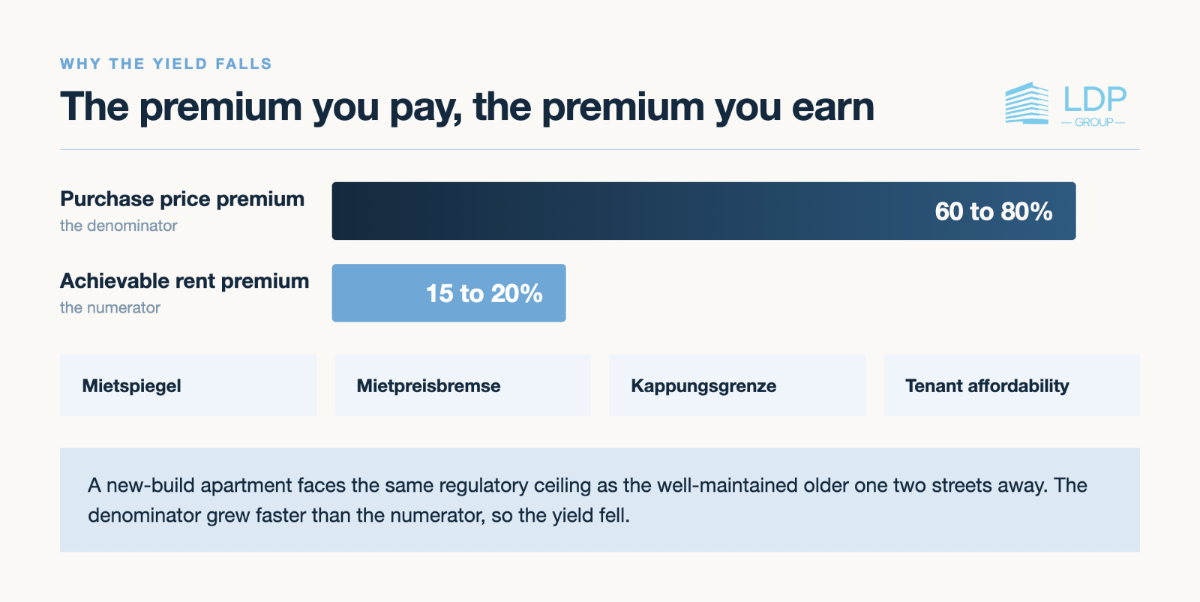
Purchase Price Premium vs Achievable Rent Premium
The result is arithmetic rather than opinion. The denominator grew faster than the numerator, so the yield fell. And because the new-build premium is already priced in on day one, the upside has been paid for in advance. There is only so far rents can rise before they hit the same regulatory ceiling everyone else hits.
Existing property in a good location does the opposite. You buy at a price that reflects the current condition, and the gap between what it earns now and what it could earn after modernisation is yours rather than the developer's.
That is the whole thesis. Everything below is about whether the tax argument for new build is strong enough to overturn it.
The new-build tax case, stated fairly
It is a genuine advantage and worth stating properly.
Newly built residential property qualifying under § 7 Abs. 5a EStG can be depreciated at 5% on a declining-balance basis, where construction began after 30 September 2023 and before 1 October 2029, or where the purchase contract falls in that window. Depreciation is heaviest in the early years, exactly when financing costs bite hardest.
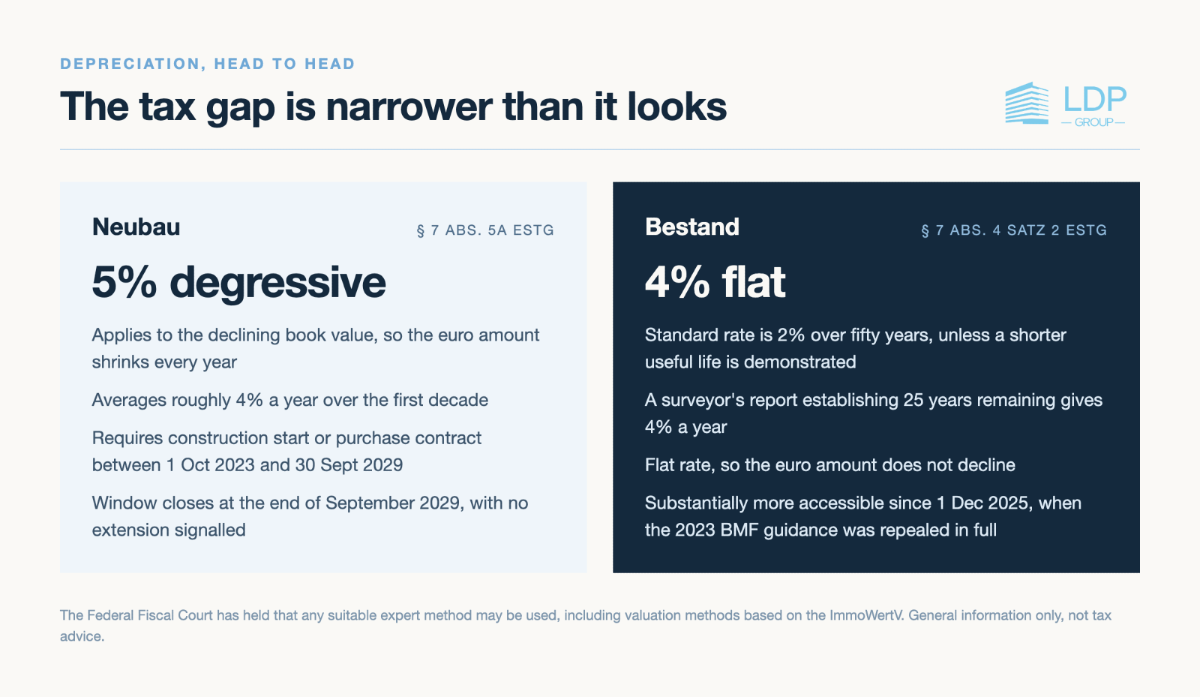
The Tax Gap is narrower than it looks.
Two things temper it. The rate applies to the declining book value, not the original cost, so the 5% shrinks every year. Over the first decade it averages roughly 4% annually against the 3% linear rate a post-2023 building would otherwise get. That is a real but moderate advantage, not the step change the marketing implies.
And it is temporary. The window closes at the end of September 2029, and the legislature has signalled it does not expect to extend it.
The two levers on existing property
A shortened useful life. German tax law sets standard depreciation rates, typically 2% over fifty years for buildings from 1925 to 2022. But § 7 Abs. 4 Satz 2 EStG expressly allows a shorter actual useful life to be applied where it can be demonstrated, usually by a surveyor's report. The rate is simply the inverse: a report establishing 25 years remaining gives 4% a year.
This route became substantially more accessible on 1 December 2025, when the finance ministry repealed its 2023 guidance in full. That guidance had imposed heavy requirements on who could produce a report and what it had to contain. What now applies is the statute and the case law, and the Federal Fiscal Court has held that any suitable expert method may be used, including valuation methods based on the ImmoWertV.
Note what that does to the comparison. Four percent flat, indefinitely, on an existing building, against a declining-balance rate on a new one that averages roughly the same over ten years and then keeps falling. The new-build depreciation advantage is far narrower than it appears, and in many cases it disappears entirely.
Immediately deductible renovation. Renovation work on a rental property can be deducted in full in the year you pay it, provided it stays under 15% of the building's purchase price during the first three years of ownership. Cross that line and the whole amount is capitalised and written off over decades instead.
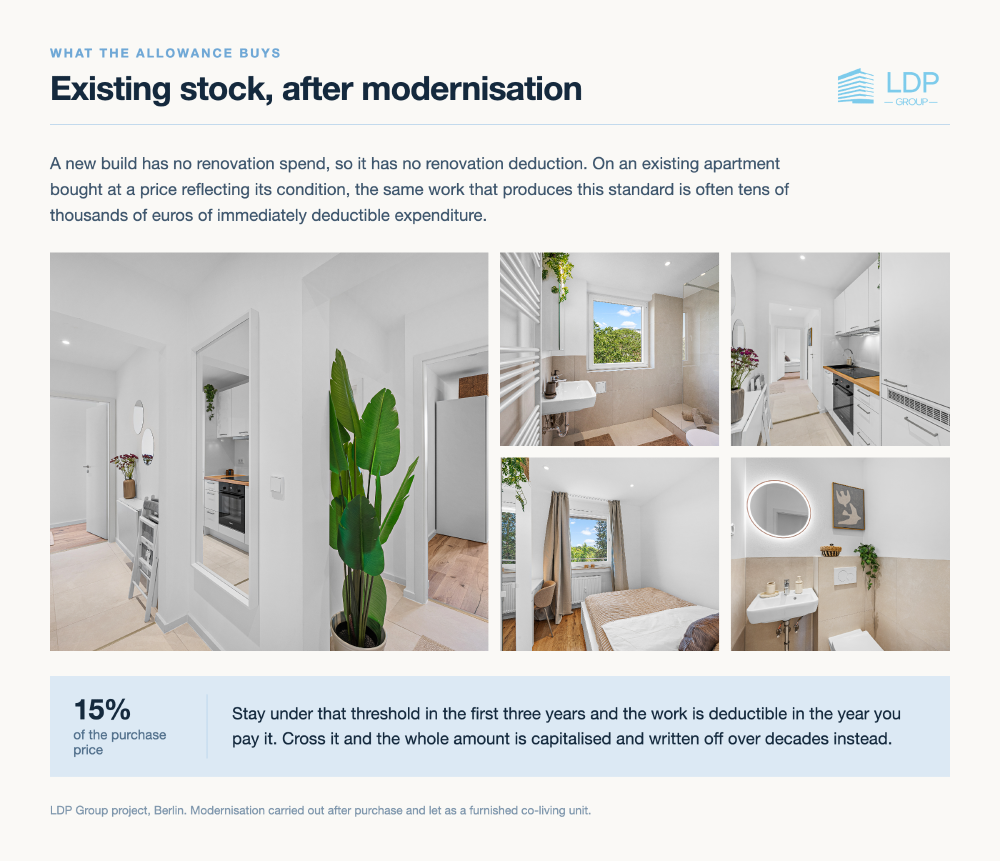
Existing Stock, after modernisation
This lever exists only where there is something to renovate. A new-build has no such spend, so it has no such deduction. On an existing apartment bought at a price reflecting its condition, that allowance is often tens of thousands of euros of immediately deductible expenditure, which arrives in the same years the degressive depreciation was supposed to be helping.
Where the two levers collide
Here is the part that gets missed, and it matters if you plan to do both.
A shortened useful life rests on the building's condition. Where a property has just been comprehensively refurbished and the substance is effectively as-new, the tax office will regularly refuse a shortened life. The refurbishment that generated your immediate deduction can undercut the report that raised your depreciation rate.
The two are not incompatible, but they have to be sequenced deliberately: what is surveyed and when, what scope of work is done, and in which order. Done thoughtlessly, you get one lever and lose the other. Done properly, you can often have both
This is the single strongest reason not to approach a Bestand purchase as a sequence of independent decisions.
Where new build genuinely wins
We would not steer every client to existing stock, and there are cases where new build is the better answer.
If you cannot tolerate capital expenditure risk, new build removes it, at a price. If you want minimal involvement and no renovation decisions from abroad, new build is simpler. If you are close to the top marginal rate and specifically want losses concentrated in the next three or four years, degressive depreciation combined with the § 7b special allowance can be compelling. And if you are buying to occupy later rather than to yield, the calculation changes entirely.
What we would not do is choose new build because the yield gap is being justified by a depreciation advantage that a surveyor's report can substantially close.
Why LDP Group focuses on Bestand
Our clients are international investors buying German residential property for yield. On that objective, existing stock in strong locations has consistently produced better numbers than comparable new build, and the gap has widened as new-build pricing has run ahead of achievable rents.
We are property advisors, not tax advisors, and the depreciation and deduction questions above are decided by the Steuerberater we coordinate for you. What we manage is the property side: sourcing units where the yield actually works, modelling the renovation allowance before you make an offer, reviewing the purchase contract including the price allocation that sets both your depreciation base and your renovation headroom, and sequencing the survey and the works so the two tax levers do not cancel each other out.
Looking at German property?
If you are weighing a new-build unit against an existing one, the honest comparison takes about an hour and needs the actual numbers for both. We are happy to run it with you, including the case where new build turns out to be the right answer.
LDP Group advises international investors on German residential property, from sourcing and contract review through to letting and rental management. Get in touch at ldp.group.
General information only, not tax advice within the meaning of the Steuerberatungsgesetz. LDP Group does not provide tax advice. Tax treatment depends on individual circumstances and legislation changes. Reflects the law as at the date of publication.