
KfW Changes July 2026: What German Landlords Lost While Homeowners Gained

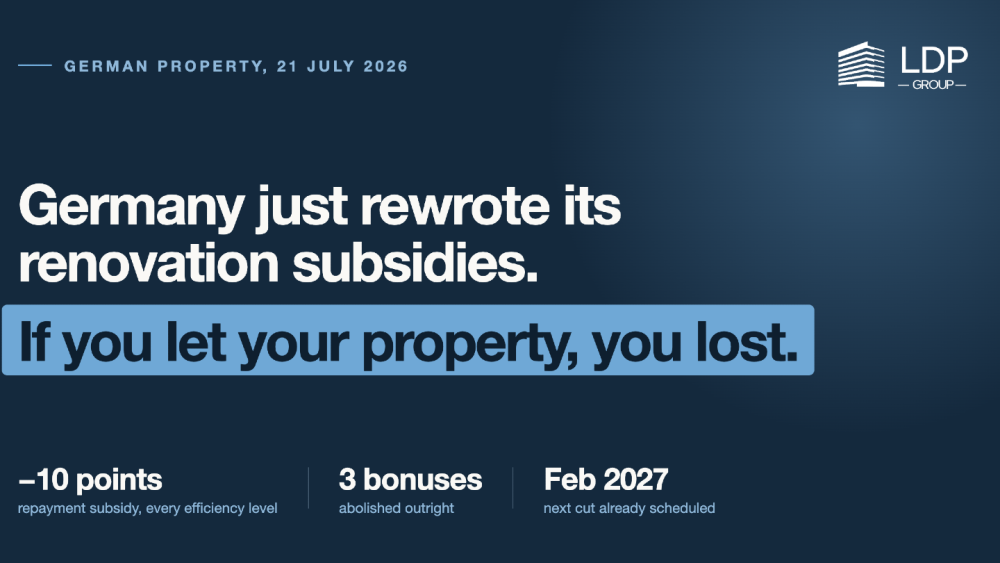
Germany just rewrote its renovation subsidies.
If you read the German coverage of Germany's July subsidy reform, you would come away thinking renovation just got cheaper. Headlines led with a new income-based bonus worth up to 40% of eligible costs.
That bonus is for owner-occupiers. If you let your property, you do not get it.
What you do get is the other half of the reform, and that half took things away.
What changed on 21 July 2026
Same reform, opposite directions
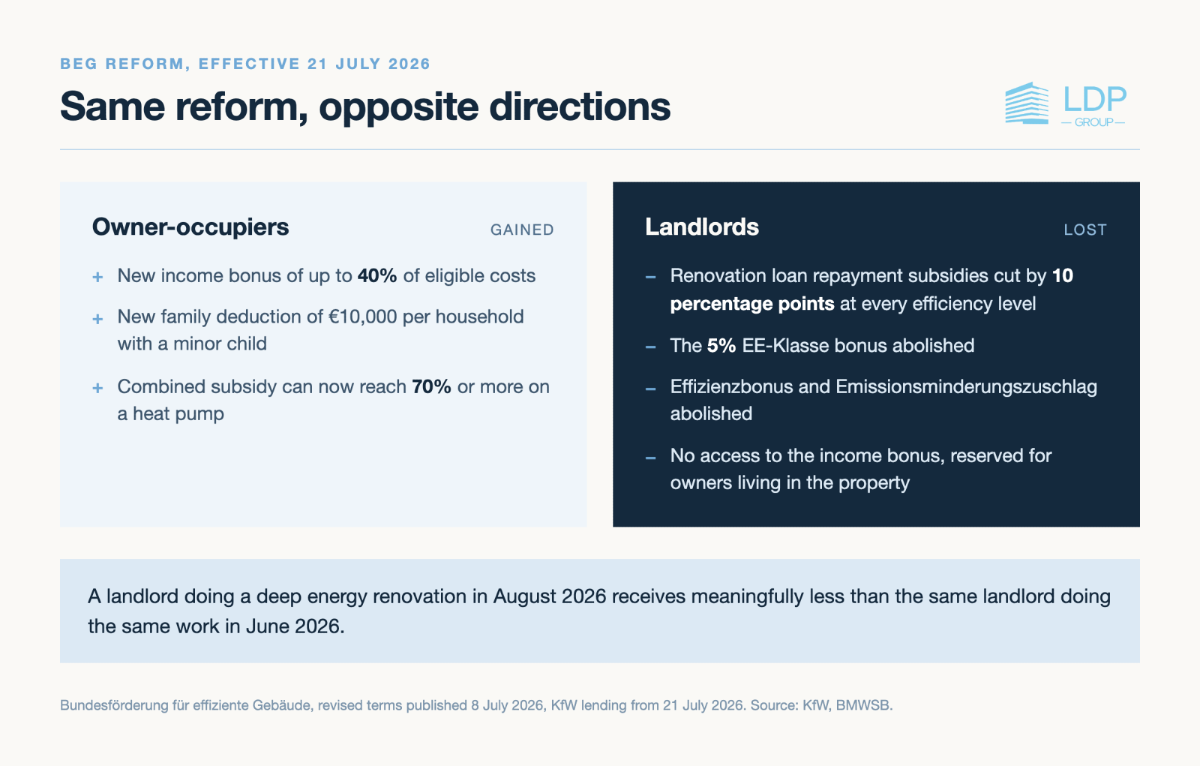
The federal government published revised terms for the Bundesförderung für effiziente Gebäude on 8 July, and KfW began lending under them on 21 July. Four changes matter for landlords.
The 5% bonus for reaching an Effizienzhaus standard with the renewable energy class (EE-Klasse) is gone.
Repayment subsidies on renovation loans, the portion of the loan you never pay back, have been cut by a flat 10 percentage points across every efficiency level.
The Effizienzbonus and the Emissionsminderungszuschlag have both been abolished.
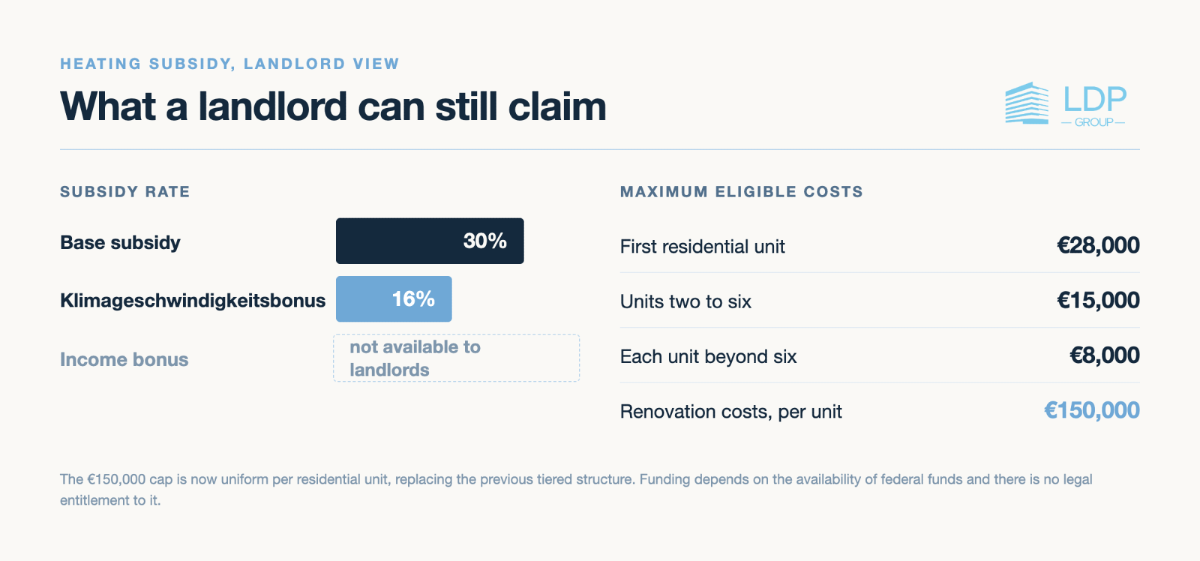
The cap on eligible renovation costs is now a uniform 150,000 euros per residential unit, replacing the previous tiered structure.
On the heating side, the base subsidy of 30% survives, and so does the Klimageschwindigkeitsbonus at 16%. The maximum is 28,000 euros for the first unit, 15,000 for units two through six, and 8,000 for each unit beyond that. Landlords can still claim these. What landlords cannot claim is the income bonus, which is explicitly reserved for owners living in the property.
Why this reads worse than the headlines suggest
What a landlord can still claim
Put plainly: a landlord doing a deep energy renovation in August 2026 receives meaningfully less than the same landlord doing the same work in June 2026. The 10 point cut to the repayment subsidy alone is worth five figures on a full refurbishment.
Meanwhile an owner-occupier on a modest income can now reach 70% or more on a heat pump. Same reform, opposite directions, and only one of them made the headlines.
For international investors this is a particular trap, because the natural way to research German subsidies is to skim German articles or run them through a translation tool. Those articles are written for the domestic majority, who are homeowners. The distinction between selbstnutzende Eigentümer and Vermieter is doing enormous work in that text, and it does not survive translation intact.
The clock is already running again
Two dates are worth writing down.
1 February 2027. Maximum heating subsidy amounts begin falling by 750 euros, and then again every six months. The Klimageschwindigkeitsbonus starts dropping by 4 percentage points on the same schedule. Waiting costs money in a fully predictable way.
Q1 2027. A Wertschöpfungsbonus arrives. The base subsidy on all heat pumps falls to 15%, and heat pumps manufactured within the EU receive a 15% bonus to compensate. If your installer sources outside the EU, that is a 15 point difference on the same equipment.
One more thing worth knowing, because it is easy to miss in translation. KfW states plainly that funding depends on the availability of federal funds and that there is no legal entitlement to it. A subsidy you have been promised is secure. A subsidy you are planning around is not.
What this changes in practice
Not whether to renovate. Energy standards in German rental stock are becoming a letting issue and a valuation issue independently of what KfW pays.
What it changes is sequencing and arithmetic. Projects that were marginal under the old repayment subsidies may not clear the bar under the new ones. Projects timed for spring 2027 are now competing against a declining subsidy schedule. And the 150,000 euro per unit cap changes how a multi-unit refurbishment should be structured.
It also interacts with something most foreign investors have never heard of. German tax law lets you deduct renovation costs immediately, but only up to 15% of the building's purchase price within the first three years. Subsidies are deducted from your costs before that calculation runs. A KfW grant therefore changes your tax position as well as your cash position, and the two need modelling together rather than separately.
How LDP Group helps
We are property advisors, not energy consultants or tax advisors. What we do is make sure the pieces are assembled in the right order, and that nothing gets decided in the wrong language.
We model the renovation case for a specific property before you commit, including which programmes a non-resident landlord can realistically access. We coordinate the Energieeffizienz-Experte whose confirmation KfW requires before any application, and the English-speaking Steuerberater who handles the tax side. We sequence the work against both the subsidy calendar and the three-year tax window. And we translate what you are actually agreeing to, at the point where it still matters.
Buying or renovating in Germany?
Subsidy conditions have now changed four times in eighteen months, and the next scheduled step is February 2027. Anything you read that predates 21 July 2026 is describing a scheme that no longer exists.
If you own German rental property or are looking at one that needs work, we can model your position under the current rules and tell you honestly whether the numbers still work.
LDP Group advises international investors on German residential property, from acquisition and contract review through to letting and rental management. Get in touch at ldp.group.